

Smart Farming, Food Science, and the Role of Technology
Agriculture occupies a central position in global economic and social systems. With close to one billion people engaged in the sector, representing approximately 28 percent of total global employment, it remains the world’s largest employer. In several countries like Comoros, Guinea-Bissau, Ethiopia, and Niger, the agricultural sector acts as the backbone of the economy, serving as the primary source of export income and contributing a significant portion to the country’s Gross Domestic Product (GDP), directly through on-farm production and indirectly through allied industries such as processing, logistics, and input markets.
Even though this sector is crucial to livelihood and food supply, it faces persistent challenges, such as climate change, limited quality land, high production costs, post-harvest losses, and other factors. Addressing these issues increasingly depends on utilizing digital technologies, smart farming techniques, as well as advances in food science and agriculture technology research to reduce loss, improve safety, and extend shelf life across the value chain.
What is Smart Farming?
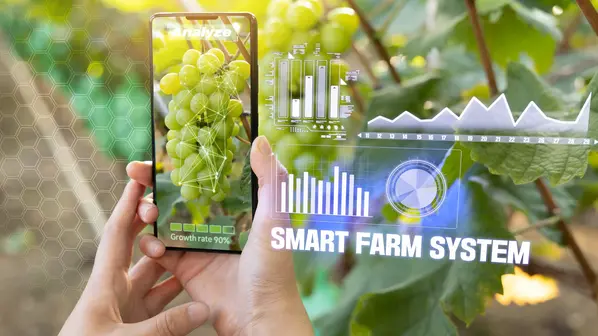
Smart farming refers to the integration and adoption of modern technologies in agricultural activities to improve the quality and quantity of agricultural outputs. It employs hardware (Internet of Things or “IoT”) and software (Software as a Service or “SaaS”) to collect data and provide actionable insights that can help facilitate major operations on the farm, both pre and post-harvest. In short, smart farming technologies focus mainly on managing farms, plantations, and all farming-related activities using IoT drones, software, machinery, artificial intelligence, and more to improve resource efficiency and decision-making throughout the production cycle.
Smart framing technologies assist in reducing manual labor, reducing financial burden, increasing yield production, and making agricultural products cost-effective. As the global population rises, it puts demand on farmers and the agricultural industry to produce enough food to match the food supply and demand. Scientists estimate that by 2050, the world’s population will grow to over 9 billion people, which is an increase of over 2 billion people. This will require the industry to produce around 60 percent more food by 2050 than it does today, making smart farming a key player in meeting the swelling population’s food requirements.
Understanding Food Science in the Modern Age
Food science is an emerging discipline that plays a crucial role in ensuring a sustainable, nutrient-dense, safe, and abundant food production system for lives today and in the future. Food science is a blend of various sciences and engineering disciplines, including chemical engineering, chemistry, and biology, which is applied for a better understanding of food and its transportation, and utilizes these learnings to deliver safe, healthy, and quality food products to the consumer.
Key aspects of food science include:
Food Chemistry and Analytical Science: Examine the molecular composition and transformations of food (proteins, lipids, carbohydrates, water, micronutrients) to understand and control texture, flavor release, color stability, nutrient retention, and functional properties. This also includes analytical methods to quantify quality markers, contaminants, and authenticity.
Food Microbiology and Safety: Study microorganisms that cause spoilage or foodborne illness, and helps design interventions to reduce risk across the chain. This spans hygienic design, fermentation control, thermal and non-thermal processing (e.g., pasteurization), packaging atmospheres, and safety systems such as HACCP and traceability to prevent and manage outbreaks.
Processing, Preservation, and Product Development: Help develop processes that extend shelf life while protecting sensory and nutritional quality. Beyond freezing, drying, and canning, this includes dehydration kinetics, water activity control, hurdle technology, and minimally processed approaches, in addition to formulation strategies that maintain quality at scale.
Food Engineering and Packaging Systems: Apply engineering principles to design scalable, energy-aware manufacturing and packaging that protects food during storage and distribution. This covers heat and mass transfer, process optimization, cold chain integrity, and packaging innovation such as barrier materials, active packaging (oxygen scavengers), intelligent packaging (time-temperature indicators), and sustainable alternatives.
Key Technologies in Smart Farming
Smart farming uses agriculture technology examples like IoT sensors, drones, GPS-based precision farming, AI analytics, smart irrigation systems, Radio-Frequency Identification (RFID) tags, and cloud platforms to monitor fields, automate tasks, and guide decisions using data. These tools improve productivity, reduce input waste, and support better quality, traceability, and supply chain coordination.
IoT
Modern agricultural equipment requires the functioning of a huge network of sensors, drones, applications, and other software, which is not easy to manage. But IoT is the emerging technology that solves this problem by connecting all available data sources into one single remote functional system with the help of the Internet and wireless connectivity. With IoT-enabled devices, farmers can manage all equipment and data in real-time without going into the field. It also allows farmers to collect and analyze data on soil conditions, growth rate of crops, and other environmental factors, which leads to improved decision-making and optimal resource management.
Wireless Sensor Networks (WSNs)
WSNs are small sensors placed across a farm to measure key conditions like soil moisture, temperature, humidity, and light. These sensors send the data wirelessly to a phone, computer, or central system for analysis. This helps farmers monitor fields continuously and make timely decisions on irrigation, fertilization, and crop care. WSNs create a direct link between the physical farm and digital systems, supporting IoT-based farming. They are affordable, rugged, and can run long on low power.
Cloud Computing
Cloud computing implies using online servers (instead of your own computer) to store, access, and process data through the internet. In agriculture, it helps farmers, researchers, and companies save farm data like weather, soil readings, and crop records in one place and share the same easily. A cloud service provider offers these tools and storage at a lower cost because many users share the same infrastructure, and you only pay for what you use.
Big Data
There used to be a time when agriculture was treated as an intuitive space, where knowledge was passed down from generation to generation. However, with modern farming practices, times are changing. With big data, farmers are now able to take maximum advantage of technologies and farm better. They can produce better crops by analyzing the soil and weather conditions. They are also able to reduce losses, such as crop spoilage, transportation delays, storage damage, and price fluctuations, by analyzing real-time market trends, supply chain data, pest patterns, and demand forecasts. In many cases, data can detect patterns that humans may overlook, eventually assisting in effective and quality farming.
Mobile Computing
Mobile computing implies using phones and tablets to share information through the internet. It is gaining popularity as it is easy to use, affordable, and available almost everywhere, making it popular among farmers. Mobile-based systems can send farmers regular updates such as weather alerts, pest warnings, market prices, and crop advice for each season. With these timely messages, farmers can make quicker decisions about irrigation, spraying, harvesting, and selling their produce.
RFID Technology
RFID uses small tags and scanners to identify and track items using radio signals. In agriculture, it is commonly used to tag livestock for easy identification and health tracking. As RFID becomes cheaper and faster, it can also be used for crops, packaging, and storage. RFID supports food traceability, improves precision farming records, and helps monitor cold-chain conditions during transport and storage.
Conclusion
The development of modern technologies impacts all spheres of human activity, including the agricultural sector. Smart farming is the future of agriculture. It helps farmers manage their work better, grow more food for a rising population, and at the same time protect the environment in a responsible and sustainable way. This shift creates positive change by improving productivity and day-to-day efficiency in agricultural activities, while also strengthening the competitiveness of farm products.
FAQs
How does technology improve food safety?
Technology helps keep food safer by monitoring, tracking, and reducing contamination risks.
- Tracks food from farm to shelf (traceability)
- Monitors temperature and hygiene in real time
- Detects contamination faster and reduces spoilage
Is smart farming expensive for small farmers?
The cost incurred depends on the tools used, but smart farming can start small and scale over time.
What role does technology play in agriculture?
With the help of technology, farmers can produce higher-yielding crops by analyzing soil conditions, moisture content, and weather forecasts. Technology also helps farmers manage operations and prevent losses from transportation costs, crop spoilage, etc.
How is AI transforming agriculture?
AI turns farm data into clear actions, helping farmers respond faster and plan better.
- Predicts yield, weather risk, and pest outbreaks
- Detects crop disease from images
- Optimizes irrigation and nutrient decisions
What are the risks of relying on agriculture technology?
Like any system, technology brings risks if access, data, or support is weak. Some of the risks include:
- High cost of equipment repair and software maintenance charges
- Overdependency on technology
- Risk of data theft or hacking
- Lack of proper training to use tools
How does food science benefit from digital innovation?
Digital innovation in food science helps in:
- Improving food quality and safety
- Helps in detecting contamination fast
- Extends shelf life through better preservation methods
- Reduces food waste with better storage