

DOI (Digital Object Identifier) in Scholarly Publishing
As technology advances, so does the size of the web, which grows more enormous with each passing day. It is no secret that search engines are facing numerous problems in discovering and retrieving digital objects. The number of websites has jumped from nearly 17 million in 2000 to over 1.2 billion in 2025. This number is expected to rise by 1000% in the near future.
In this article, we will learn more about the Digital Object Identifier (DOI), how it supports scholarly publication, and why it remains essential in the digital research ecosystem.
What is a DOI and How Does it Work?
A DOI is a unique, persistent alphanumeric string assigned to a digital object to provide permanent and actionable identification in a digital environment. It stores the essential information about research articles or documents, such as the title, author, publisher, and a link to where the content is located.
Legacy identifiers such as ISBN and ISSN were originally established for print publishing, but they do not provide sufficient identification for the electronic environment. This limitation led the Association of American Publishers (AAP) to form a partnership with the Corporation for National Research Initiatives (CNRI) to develop the DOI systems specifically for digital materials. They were officially launched in the second half of 1997 at the Frankfurt Book Fair.
DOI systems were originally established to standardize the process of identifying and accessing digital objects, regardless of changes in metadata or location. A DOI contains metadata and a resolution link to the original content. Even if the resolution link is moved to another website or platform in future, publishers have to update only the resolution link in one place and all the existing links will function and direct readers to the updated location.
Understanding DOI Structure
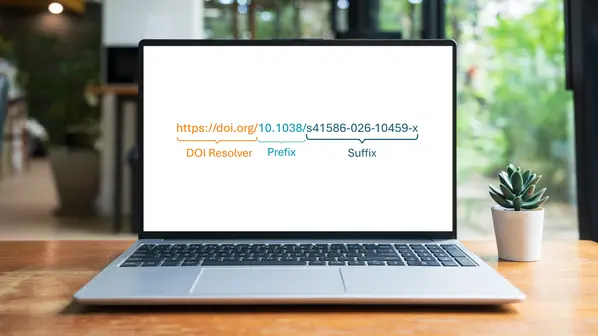
A DOI citation follows a certain form and sequence of characters that helps identify digital research. Although there’s no defined limit on the length of the DOI, every DOI has three main elements: the DOI resolver, prefix, and suffix.
Click here to see the DOI diagram [Image: Created by Cureus Journals].
DOI Resolver: A DOI resolver is a web based proxy service (commonly https://doi.org) that interprets the DOI string and queries the “Handle System,” a global distributed infrastructure for managing persistent identifiers, to retrieve the current URL associated with the DOI and redirect users to the digital content.
Prefix: This identifies the publisher organization that is accountable for managing the DOI. It begins with “10,” which is the standard directory code used in most DOIs. The string of numbers in the prefix is followed by a forward slash (/). Every publisher has a unique DOI prefix.
Suffix: This is the element that comes after the prefix slash and the article identifier code is placed here. Out of the three elements of a DOI, publishers or organizations are responsible for creating and managing the suffix.
Key elements of the DOI suffix:
- Each DOI suffix should be unique
-
Suffixes can be any alphanumeric string which includes combinations of the following approved characters:
- Roman Alphabet letters (A to Z).
- Numbers (0 to 9)
- A DOI can contain only a few approved special characters, such as the standard hyphen (-), period (.), underscore (_), semicolon (;), parentheses (), and forward slash (/). However, only the regular keyboard hyphen is allowed in a DOI. Other dash styles, such as en dash (–) or em dash (—), are not accepted.
- Suffixes are case insensitive, they do not differentiate between 10.110/ABC and 10.110/abc.
Why is a DOI Essential?
In scholarly publishing, citations help readers trace ideas, verify sources, and connect related research. However, digital content can become difficult to access when URLs expire, journals shift platforms, publishers merge, or repositories are reorganized. A standard web link may break, making it harder for readers, researchers, and databases to locate the original work. This is where the DOI becomes important. A DOI gives a research article, dataset, book chapter, or other scholarly output a persistent identity. Even if the content moves to a new website, the DOI can continue to direct readers to the correct location when the publisher updates its DOI record.
For academic publishing, DOIs improve citation accuracy, reduce broken links, support indexing and metadata management, and make research easier to find, share, and track across journals, repositories, and scholarly databases.
Common DOI Registration Agencies
Each DOI registration agency provides services to the specific community it serves. Some of the common DOI registered agencies are:
CrossRef: It is one of the largest global organizations that assign and administer the DOI for research papers. It is commonly used by academic journals, books, publishers, and conference proceedings. It is run by an independent nonprofit organization, known as Publishers International Linking Association (PILA). Since its implementation, DOI has become the backbone of scholarly publishing.
DataCite: This non-profit organization provides DOIs mainly for research data and other research outputs. Its goal is to make research data more findable, shareable, citable, and reusable.
Entertainment Identifier Registry (EIDR): It is a DOI registration agency used for entertainment and media content. It assigns unique digital identification to content such as movies, TV shows, webseries, music videos, trailers, and streaming content.
OP: The Publications Office of the European Union (OP) serves as the official publishing body for various European Union institutions, agencies, and offices. It is responsible for assigning DOIs to digital content created by these organizations. The content covered under this system includes EU publications, online research articles, datasets, grants, and other official digital resources.
Conclusion
DOIs, or Digital Object Identifiers, play an important role in research and academic publishing by providing a permanent and reliable way to identify digital content such as journal articles, datasets, and research outputs. They improve discoverability, accessibility, citation accuracy, and long-term preservation of research materials. DOIs also help researchers receive proper credit for their work and make it easier to share and reuse scholarly content, supporting more reliable and connected academic communication worldwide.
FAQs
How does a DOI work?
A DOI provides permanent and actionable identification to the digital object. It aims to provide a standardized way to identify and access the digital object, regardless of changes in metadata or location.
How can I find the DOI of an article?
You can usually find the DOI:
- on the first page of the article
- near the abstract
- in the citation information
- on the journal website
- through Crossref or Google Scholar search
Is DOI required in academic publications?
DOIs are not always mandatory in academic publications. But academic journals strongly recommend using them for better discoverability of the research work and improving citation.
How does DOI improve research discoverability?
DOIs make research easier to:
- find online
- cite correctly
- access permanently
- connect with databases and search engines
How do publishers register a DOI?
Publishers register DOIs through DOI registration agencies such as Crossref or DataCite. The publisher submits the article details and metadata, and the agency assigns a unique DOI to the content.